Introducing Clothbound: a calm, local-first ebook reader for Linux
Introducing Clothbound
Clothbound 0.4 is out. It's a calm, local-first EPUB and PDF reader for Linux and Omarchy, and it's free and open source under the MIT license.
curl -fsSL https://clothbound.app/install | bash
Why I built it
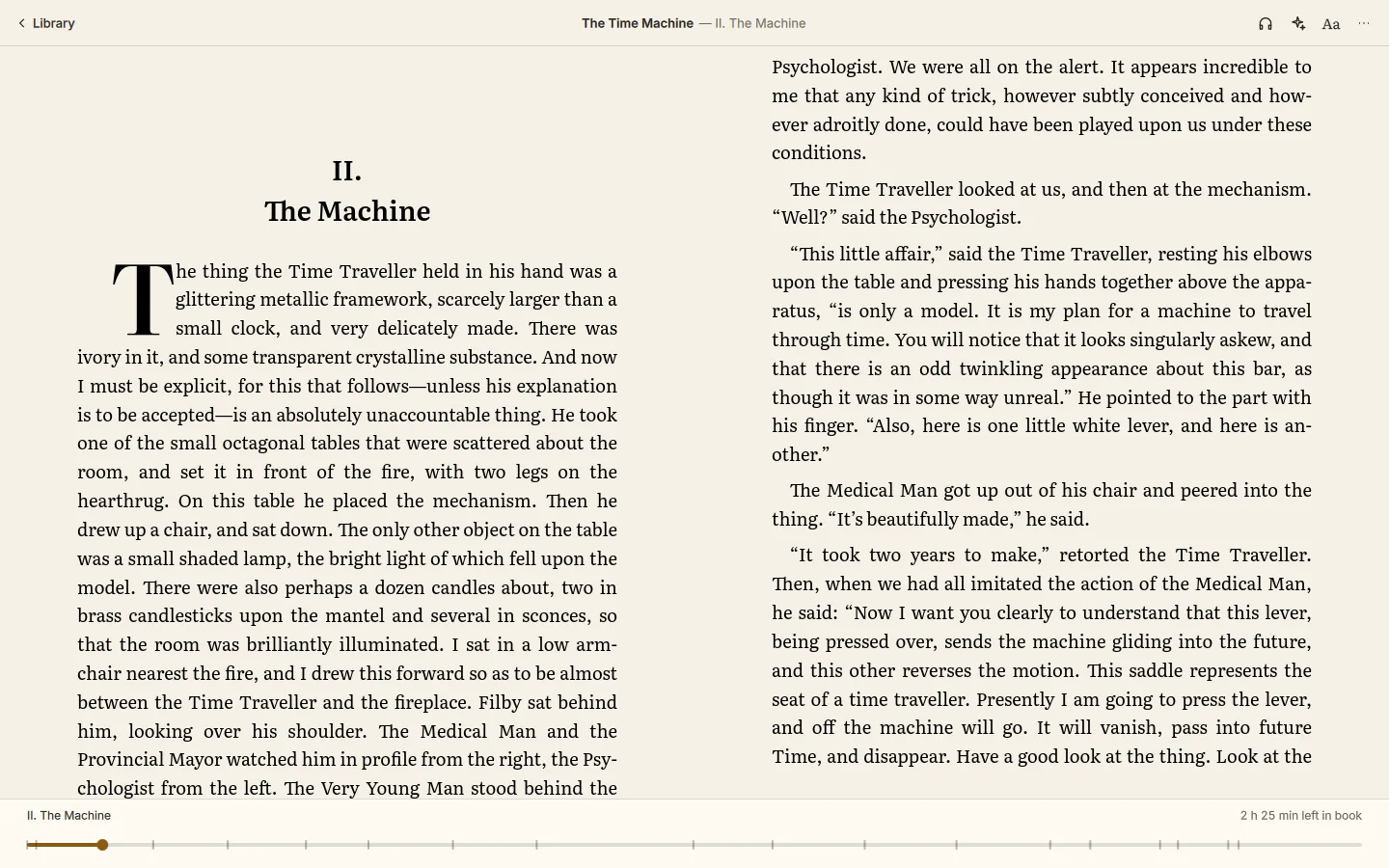
My Omarchy desktop had no ebook reader I liked. The options were either web apps in a wrapper, or tools that looked nothing like the rest of my desktop and wanted a mouse for everything. I wanted something closer to a good paperback: open the book, and everything else gets out of the way.
So I set a few rules for myself:
- Native and fast. Qt 6 and C++, one binary, no Electron.
- Keyboard-first.
Ctrl+Kfor everything,hjklto move around,?when you forget. - It belongs on the desktop. It follows your Omarchy theme, language and corner rounding as they change.
- Your books stay yours. It never modifies your files, and nothing leaves your machine unless you switch it on.
What it does
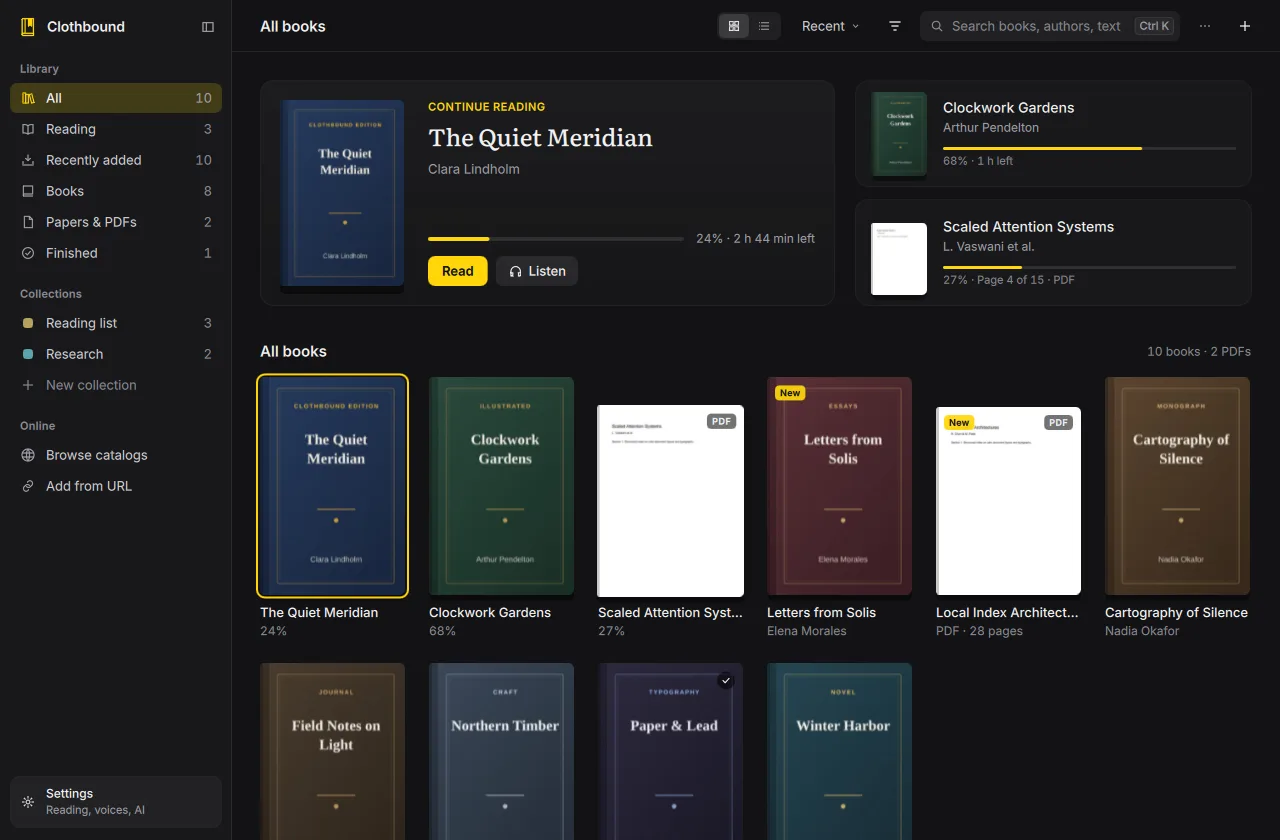
A library that stays out of the way. Point it at the folders where your books already live. You get covers, shelves and collections, editions grouped together, and reading stats. Paste any article URL and it's saved as a clean offline EPUB on your Articles shelf. It also browses OPDS catalogs such as Standard Ebooks and Project Gutenberg, or your own Calibre-Web, Kavita or Komga server.
Search that knows what's inside. Ctrl+K searches titles, chapters, your highlights and the full text of every book, all from a local index. Turn on search by meaning and it finds passages that are about what you typed, even when the words don't match.
A calm page. EPUBs get flicker-free page turns, drop caps, hyphenation and five reading themes. PDFs are recolored to match your theme, with their white margins cropped away.
Read-aloud that sounds human. Press P and the book is read to you with the current sentence highlighted. Narration runs offline with built-in neural voices (Kokoro, Piper and Pocket TTS, across 42 languages), and you can export a book as a chaptered M4B audiobook.
A companion that won't spoil the ending. Press C to ask questions about what you're reading, get a "previously…" recap, or check who's who. In Story mode it only knows the book up to your current page, so it can't give away the plot. Study mode adds a glossary and briefs across a whole book or a whole shelf.
Built for papers, too. Drag a box around part of a PDF to have it explained, copied as LaTeX, or turned into a table. arXiv IDs and DOIs are detected for you.
Your library, available to your AI tools. clothbound mcp runs a read-only MCP server, so coding and research agents like Claude Code or Cursor can search and quote your own books, privately.
It also ships in all 50 of Omarchy's interface languages.
Local-first, not cloud-first
Every feature that uses a model is optional. Clothbound is a complete offline reader without one.
When you do want the smart features, you choose where they run:
- On this computer: built-in voices run inside the app, and Clothbound detects a local model server (Ollama, llama.cpp, LM Studio, MLX or vLLM) if you have one.
- In the cloud: Gemini, with your own API key. It shows cost estimates up front and respects a monthly budget cap.
- Hybrid: local for the everyday features, cloud for the heavy ones.
A built-in Test this computer check tells you honestly what your hardware can handle, rather than letting you discover it halfway through a chapter.
Under the hood
For the curious:
- EPUBs render in Qt WebEngine with a custom paginator; PDFs use QtPdf (PDFium).
- The library is SQLite with FTS5 full-text search.
- Offline voices run in-process through sherpa-onnx.
- Every AI feature talks to a small set of interfaces (text, speech, embeddings, images), with an adapter per provider. That's what makes "Gemini or your local server" a setting instead of a rewrite.
I built Clothbound with an AI coding agent as my pair programmer, and I'd rather say so up front.
What it doesn't do yet
- Linux only, and packaged for Arch-based distros. On x86_64 the installer uses the prebuilt release; on aarch64 (Asahi, for example) it builds from source.
- No Flatpak yet. That's next, so other distros can install it easily.
- No DRM-protected books.
Try it
curl -fsSL https://clothbound.app/install | bash
- Website: clothbound.app
- Code and releases: github.com/orcawhisperer/clothbound
If a book renders badly, a voice mispronounces your favourite author, or something just feels off, please open an issue. Reports from people reading in languages other than English are especially welcome.
Happy reading. 🐋